Go, Bikeboy! Go!
Platform:
Arcade Cabinet
Timeline:
4 Days
Game Overview
Roles
Game Designer
QA Tester
Technical Artist
Tools
Unity (ENGINE)
Animator
Miro
GitHub
Adobe Photoshop
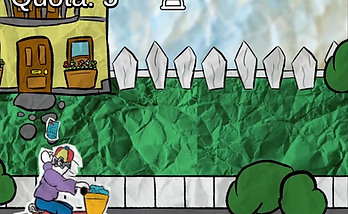
Go, Bikeboy! Go! is a microgame produced under the design challenge of making a 1-minute or under game experience focused on a single verb. It follows a newspaper delivery boy who is tasked with delivering a quota of papers without attracting the ire of the prickly neighbors.
I pitched, produced, and iterated the verb: "Deliver" to fit the desired player experience under the constraints of our design problem. As the team's lead game designer, I was also responsible for ensuring the gameplay systems were consistent with compliance testing specifications to be published in "MicroMix Vol. 1," a microgame collection that is featured to the general public through arcade cabinets scattered in Sheridan College's Trafalgar Campus. The project was a good opportunity to simulate the pipelines that studios must follow to publish on specific consoles and platforms.
My secondary role as the team's Technical Artist also allowed me to get acquainted with integrating assets and animations in-engine and develop creative solutions to our team's available skill-spread by developing a non-traditional asset pipeline.
Breakdown
Design Video (0:58)
This design week video gives a short overview of the design constraints and intended experience based on our four-day design jam.
Pitching and Designing the Verb

As part of the structure of our design week, each member of the team pitches a concept based on our shared brainstorming. The idea I came up with (pictured on the left) was the pitch that our team and consults decided had the clearest vision and most room for depth for a microgame under a minute. I used an annotated experience storyboard to dictate the flow of the game, keeping in mind the Input-Stimulus-Output dynamics present.

We focused on getting a playable prototype and did multiple rounds of playtesting. From that, we used affinity mapping to condense the feedback in a succinct and actionable way to make the experience tighter. We also made sure to highlight the play experiences the players appreciate most based on their interactions, and ensured that they would keep their place throughout the iterations of the game.
Compliance Testing
Because we were producing a microgame specifically to be presented in an anthology of microgames in an arcade cabinet machine, we had to make sure our game followed the technical specifications and project settings so it could properly integrate with the randomizer program that could load our builds and run in the machine itself.
As part of the procedure, I was given the opportunity to perform Compliance Tests on three other microgame builds. Two of those tests were done early in the penultimate day to emphasize which features, settings, or functionality needed to be straightened out before the end of day; the images to the right were the results of our build's test during this timeframe. Based on the results, we had a minimal revisions but reminded us to prioritize our finalized sound cues manager and visual components like our text styling. They also requested a banner to use to represent our game when it came up on the machine.
The final Compliance Check I performed was for another game's final build, which was composed of the same questions and included the meta-program's scenes to simulate it. Fortunately, both our game and the team I checked had fully compliant games and are now featured on the machines now distributed throughout the Sheridan Trafalgar Campus.

